MA Anthropology and Film and Visual Culture
Student Life #DayInTheLife
About Aberdeen
The University of Aberdeen (abbreviated Aberd. in post-nominals; Scottish Gaelic: Oilthigh Obar Dheathain) is a public research university in Aberdeen, Scotland. It was founded in 1495 when William Elphinstone, Bishop of Aberdeen and Chancellor of Scotland, petitioned Pope Alexander VI on behalf of James IV, King of Scots to establish King's College, making it one of Scotland's four ancient universities and the fifth-oldest university in the English-speaking world. Along with the universities of St Andrews, Glasgow, and Edinburgh, the university was part of the Scottish Enlightenment during the 18th century. The university as it is currently constituted was formed in 1860 by a merger between King's College and Marischal College, a second university founded in 1593 as a Protestant alternative to the former. The university's iconic buildings act as symbols of wider Aberdeen, particularly Marischal College in the city centre and the crown steeple of King's College in Old Aberdeen. There are two campuses; the predominantly utilised King's College campus dominates the section of the city known as Old Aberdeen, which is approximately two miles north of the city centre. Although the original site of the university's foundation, most academic buildings apart from the King's College Chapel and Quadrangle were constructed in the 20th century during a period of significant expansion. The university's Foresterhill campus is next to Aberdeen Royal Infirmary and houses the School of Medicine and Dentistry as well as the School of Medical Sciences. Together these buildings form one of Europe's largest health campuses. The annual income of the institution for 2024–25 was £257.2 million of which £54.2 million was from research grants and contracts, with an expenditure of £262.5 million. Aberdeen has educated a wide range of notable alumni, and the university played key roles in the Scottish Reformation, Scottish Enlightenment, and the Scottish Renaissance. Five Nobel laureates have since been associated with the university: two in Chemistry, one in Physiology or Medicine, one in Physics, and one in Peace.
What Students Say
The curriculum is highly engaging. An impressive 94% of students found this course to be consistently intellectually stimulating.
Marking and assessment is viewed as largely fair, with 73% of cohorts agreeing exams and essays were graded appropriately.
Academic support is accessible; 84% of students stated good advice was readily available when evaluating their module options.
Course organization structure is perfectly solid. Over 90% say the timetables were well-organized and running smoothly.
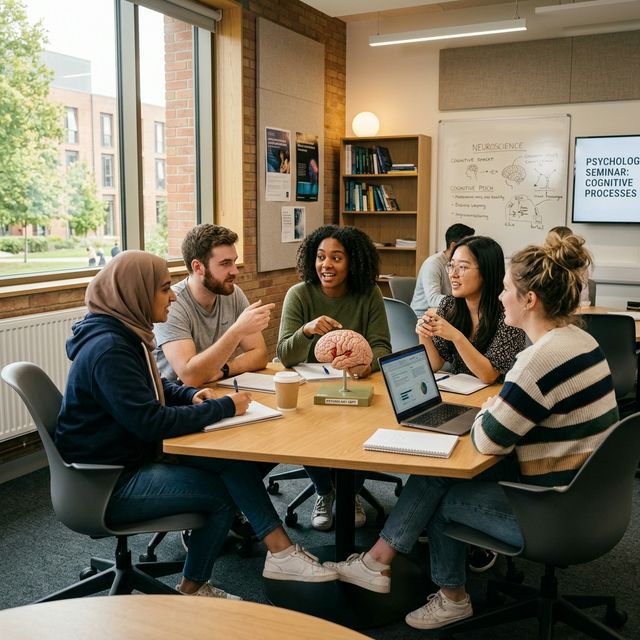
The community feel here is incredible. 94% of students agreed that they truly feel part of a community of staff and students.
The Students' Union does a massive amount of work here. 63% of us feel they effectively represent our academic interests.